
Veolia Electrodeionization EDI Stack Modules
Veolia E-Cell EDI MK-9 Stack with 8.0 m³/h Nominal Flow
1.Product OverviewThe Veolia E-Cell EDI MK-9 is an industrial electrodeionization (EDI) stack that uses electrical current to produce ultrapure water from suitably treated feed water. It is designed for continuous operation in applications including power generation, solar panel producti
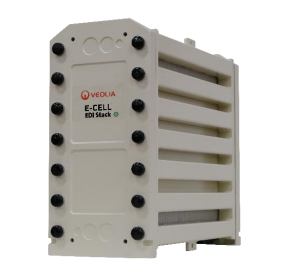
1. Product Overview
The Veolia E-Cell EDI MK-9 is an industrial electrodeionization (EDI) stack that uses electrical current to produce ultrapure water from suitably treated feed water. It is designed for continuous operation in applications including power generation, solar panel production and green hydrogen generation.
2. PRODUCT SPECIFICATIONS
Item | Specification |
Brand | Veolia E-Cell |
Model | E-Cell EDI MK-9 |
Product type | Industrial electrodeionization (EDI) stack |
Dimensions (W × H × D) | 30 × 61 × 74 cm |
Shipping weight | 165 kg (364 lb) |
3. OPERATING PARAMETERS
Parameter | Value / Range |
Nominal flow | 8.0 m³/h (35.2 gpm) |
Flow rate range | 4.2–10.0 m³/h (18.5–44.0 gpm) |
Recovery | Up to 97%; actual performance depends on site and design conditions |
Voltage | 0–400 VDC |
Amperage | 0–5.2 ADC |
Maximum inlet pressure | ≤ 6.9 bar (100 psi); required inlet pressure depends on downstream product and concentrate pressures, flow configuration and stack pressure drop |
Pressure drop | 2.4–3.4 bar (35–50 psi) at nominal flow and 25°C; verify for the specific design conditions |
Feed water temperature | 4.4–40°C (40–104°F) |
Feed water pH | 4–11 |
Total exchangeable anions (TEA, as CaCO₃) | ≤ 36 ppm; this table value applies at minimum flow and maximum temperature. Confirm acceptability for the specific operating conditions using the Winflows Design Simulator |
Conductivity equivalent | ≤ 62 μS/cm |
Total hardness (as CaCO₃) | ≤ 1.0 ppm in standard counter-current operation; ≤ 0.1 ppm in co-current operation |
Silica (SiO₂) | ≤ 1.0 ppm; the allowable limit decreases above 5 m³/h and to 0.5 ppm when feed water hardness exceeds 0.5 ppm as CaCO₃ |
Total organic carbon (TOC, as C) | ≤ 0.5 ppm |
Total chlorine | ≤ 0.05 ppm |
Fe, Mn and H₂S | ≤ 0.01 ppm |
Boron | ≤ 1.0 ppm; limited to 0.3 ppm as B when a silica guarantee or a resistivity guarantee above 10 MOhm-cm is required |
Oil and grease | None detectable |
Oxidizing agents | None detectable |
Color | ≤ 5 APHA |
Particulate control | RO permeate or equivalent feed water. If an open section separates the feed source and EDI stack, install filtration immediately before the stack |
The temperature and pH values above are feed water operating limits, not cleaning or sanitization specifications. Feed water limits and expected product water quality should be verified for the specific design using the Winflows Design Simulator and the E-Cell EDI Stack Owner’s Manual.
4. Key Features & Benefits
Continuous EDI operation: Produces ultrapure water without caustic or acid regeneration of the ion exchange resin within the stack.
Defined flow range: A nominal flow of 8.0 m³/h and specified range of 4.2–10.0 m³/h support capacity evaluation.
Counter-current operation: Helps minimize cleaning requirements at higher feed water hardness levels; the applicable hardness limit depends on flow configuration.
No brine injection or concentrate recirculation: These are not required for stack operation.
Design-specific water quality assessment: Resistivity of ≥ 16 MOhm-cm, sodium of ≤ 3 ppb and silica as low as 5 ppb are listed as guarantees available,
5. Key Applications
Demineralized feed water for high-pressure boilers in power plants and other heavy industrial sites.
Ultrapure water for rinsing solar panels and other microelectronics.
Ultrapure water for electrolyzer green hydrogen generation.
Send Your Water Treatment Requirement
Tell us the feedwater, required capacity, target water quality and project conditions. Your inquiry email will automatically include the page you are viewing so our team can understand the exact product, technology or reference that led to your request.
- Feedwater source / available analysis
- Design flow or required production capacity
- Target product-water quality or process duty
- Project country, operating conditions and delivery target