
Deionizers
Deionizers
DeionizersDEIONIZERSThe Process of Deionization or Ion-exchangeIn the context of water purification, ion-exchange is a rapid and reversible process in which impurity ions present in the water are replaced by ions released by an ion-exchange resin. The impurity ions are taken up by the resin, which m
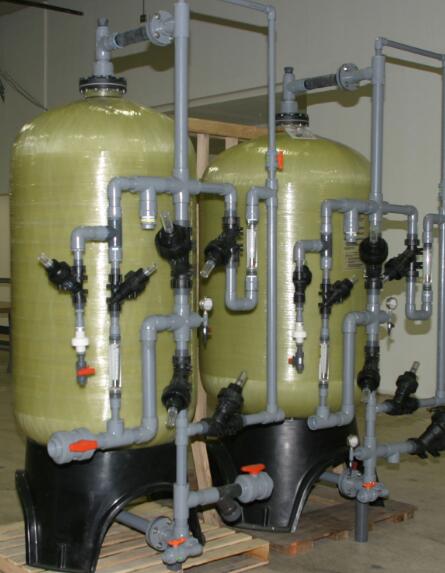
Deionizers
DEIONIZERS
The Process of Deionization or Ion-exchange
In the context of water purification, ion-exchange is a rapid and reversible process in which impurity ions present in the water are replaced by ions released by an ion-exchange resin. The impurity ions are taken up by the resin, which must be periodically regenerated to restore it to the original ionic form. (An ion is an atom or group of atoms with an electric charge. Positively-charged ions are called cations and are usually metals; negatively-charged ions are called anions and are usually non-metals).
The following ions are widely found in raw waters:
Cations: | Anions: |
|---|---|
Calcium (Ca2+) | Chloride (Cl-) |
Magnesium (Mg2+) | Bicarbonate (HCO3-) |
Sodium (Na+) | Nitrate (NO3-) |
Potassium (K+) | Carbonate (CO32-) |
Iron (Fe2+) | Sulfate (SO42-) |
ION EXCHANGE RESINS
There are two basic types of resin - cation-exchange and anion-exchange resins. Cation exchange resins will release Hydrogen (H+) ions or other positively charged ions in exchange for impurity cations present in the water. Anion exchange resins will release hydroxyl (OH-) ions or other negatively charged ions in exchange for impurity anions present in the water.
The application of ion-exchange to water treatment and purification:
There are three ways in which ion-exchange technology can be used in water treatment and purification: first, cation-exchange resins alone can be employed to soften water by base exchange; secondly, anion-exchange resins alone can be used for organic scavenging or nitrate removal; and thirdly, combinations of cation-exchange and anion-exchange resins can be used to remove virtually all the ionic impurities present in the feedwater, a process known as deionization. Water deionizers purification process results in water of exceptionally high quality.
DEIONIZATION
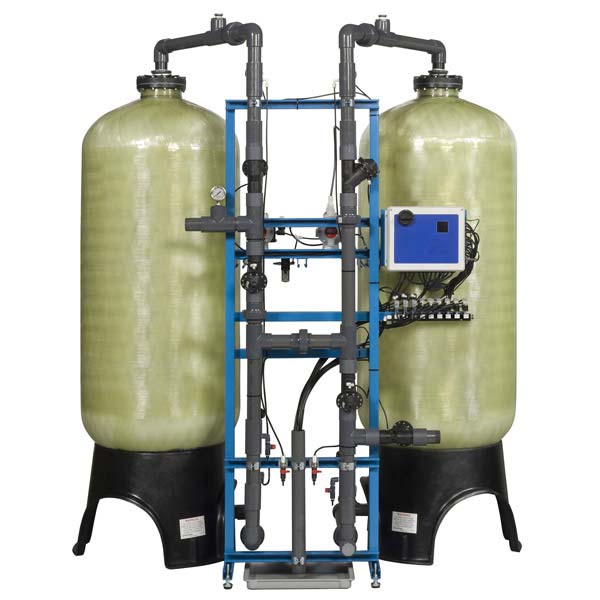
For many laboratory and industrial applications, high-purity water which is essentially free from ionic contaminants is required. Water of this quality can be produced by deionization.The two most common types of deionization are:
Two-bed deionization
Mixed-bed deionization
TWO-BED DEIONIZATION
The two-bed deionizer consists of two vessels - one containing a cation-exchange resin in the hydrogen (H+) form and the other containing an anion resin in the hydroxyl (OH-) form. Water flows through the cation column, whereupon all the cations are exchanged for hydrogen ions.To keep the water electrically balanced, for every monovalent cation, e.g. Na+, one hydrogen ion is exchanged and for every divalent cation, e.g. Ca2+, or Mg2+, two hydrogen ions are exchanged. The same principle applies when considering anion-exchange. The decationised water then flows through the anion column. This time, all the negatively charged ions are exchanged for hydroxide ions which then combine with the hydrogen ions to form water (H2O).
MIXED-BED DEIONIZATION
In mixed-bed deionizers the cation-exchange and anion-exchange resins are intimately mixed and contained in a single pressure vessel. The thorough mixture of cation-exchangers and anion-exchangers in a single column makes a mixed-bed deionizer equivalent to a lengthy series of two-bed plants. As a result, the water quality obtained from a mixed-bed deionizer is appreciably higher than that produced by a two-bed plant.
Although more efficient in purifying the incoming feedwater, mixed-bed plants are more sensitive to impurities in the water supply and involve a more complicated regeneration process. Mixed-bed deionizers are normally used to ‘polish’ the water to higher levels of purity after it has been initially treated by either a two-bed deionizer or a reverse osmosis unit
Send Your Water Treatment Requirement
Tell us the feedwater, required capacity, target water quality and project conditions. Your inquiry email will automatically include the page you are viewing so our team can understand the exact product, technology or reference that led to your request.
- Feedwater source / available analysis
- Design flow or required production capacity
- Target product-water quality or process duty
- Project country, operating conditions and delivery target